


















The Junk Drawer Isn't the Problem — It's the Solution (When You Organize It Right)
Organizing culture loves to shame the junk drawer, but here's the honest truth: every home needs one. A drawer for the batteries, the spare key, the birthday candles, the one screwdriver — that's not clutter, that's infrastructure, the same way a first-aid kit or a toolbox is infrastructure. The problem isn't having a junk drawer. It's having one with no interior structure, where finding scissors requires excavation and a running commentary of "I know they're in here somewhere." A junk drawer done right is one of the most useful three square feet in the kitchen.
Empty it once, completely
The only time you'll ever need to fully empty the drawer is today. Dump everything onto the counter and sort into three piles: things you've used this year, things that belong somewhere else, and things you kept because throwing them away required a decision you didn't want to make. Pile two gets delivered to its actual home right now, not "later." Pile three gets its decision made now — most of it is dead pens, mystery cables, and warranty cards for appliances you no longer own. Be ruthless here; nothing you rediscover in this pile has been missed in the time it's spent buried.
Give the drawer compartments
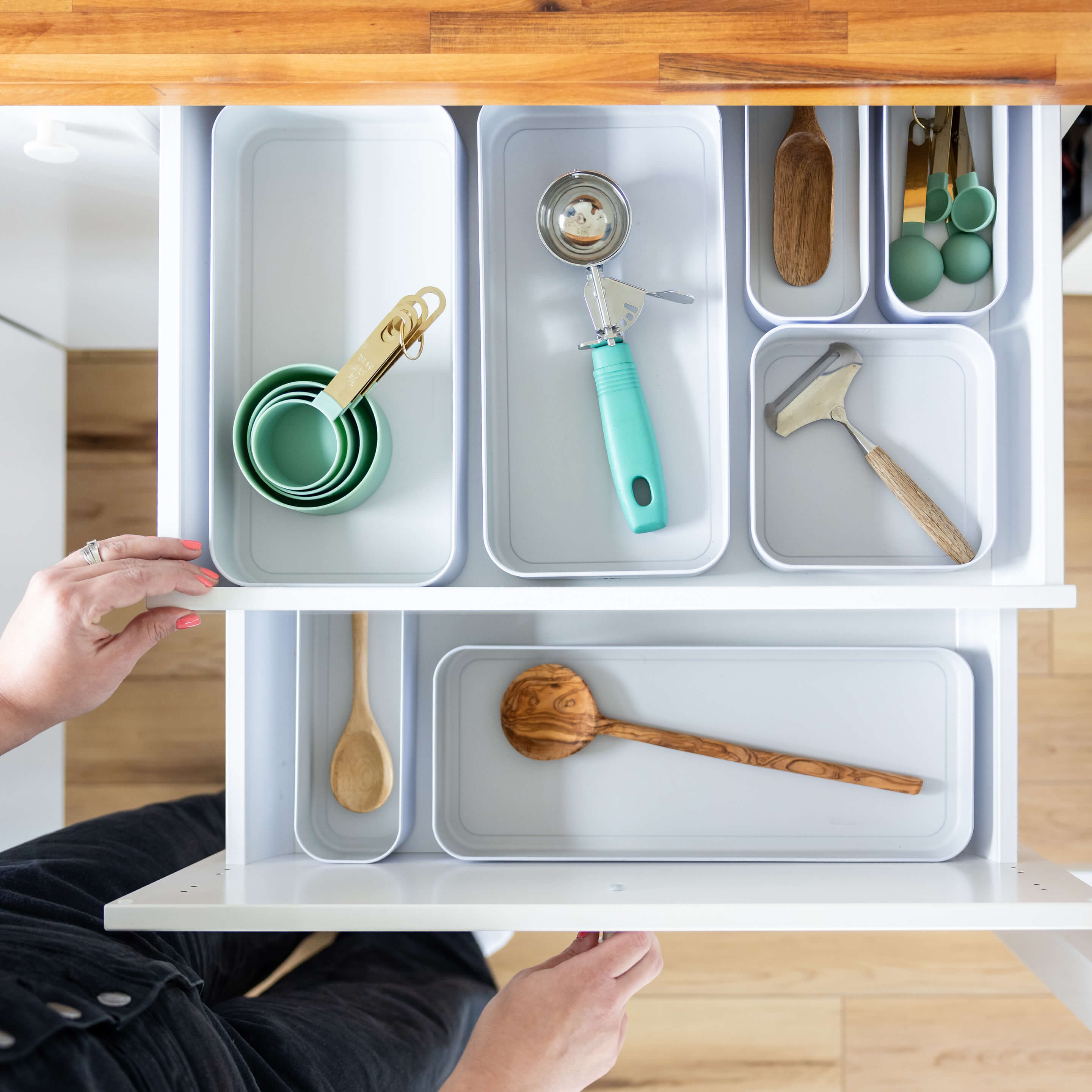
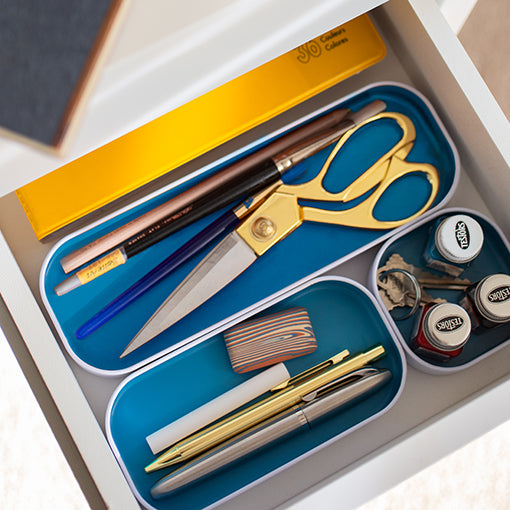
A junk drawer stays organized exactly as long as its contents can't migrate into each other's space. Metal stacking drawer organizers turn one open pit into a grid of small territories — batteries in one bin, tools in another, candles and matches in a third, rubber bands and twist ties in a fourth. Because they're stackable and come in sets, you can fit the layout to your drawer instead of forcing your drawer to fit a one-size tray that leaves awkward gaps or doesn't fit at all. The colorful bins also do something subtle: they make the drawer legible at a glance, so things go back where they came from instead of wherever there's an open inch of space.
Give categories that don't fit anywhere else a limit
Every junk drawer has a junk-drawer-within-the-junk-drawer — the odds and ends that don't cleanly belong to batteries, tools, or candles. Give that category one small compartment and a hard limit: whatever doesn't fit in it gets tossed or relocated, not shoved into a neighboring bin. Without a limit, the miscellaneous bin is the one that always wins, slowly swallowing the structure you just built. A drawer organizer only works as long as every bin has a boundary that actually gets respected.
The one-second put-back rule
Here's the test of a working junk drawer: putting something away takes one second and zero thought. If returning the tape means wedging it diagonally under the flashlight, the system's overfull, and overfull bins are exactly where migration starts — items drift to whatever bin still has room, and within a month your batteries bin has scissors in it too. Each bin should close with room to spare. If it doesn't, that's not a sign you need a bigger drawer; it's a sign something in that bin needs to leave.
Audit twice a year
Junk drawers accumulate silently — a stray receipt here, a rubber band there, and six months later the grid you built has quietly filled back in. Twice a year — daylight savings works as a reminder because it's already on your calendar for something else — take ninety seconds to pull anything that snuck in and doesn't belong. The drawer earns its keep the other 363 days, and a ninety-second audit twice a year is a small price for a drawer that never again requires a full teardown.
Frequently asked questions
Is it bad to have a junk drawer at all?
No — every home needs one. The problem isn't having a junk drawer, it's having one with no interior structure.
What organizers work best for a junk drawer?
Stackable metal drawer organizers, since they can be arranged in sets to fit your specific drawer instead of forcing your drawer to fit a fixed tray.
How often should I audit the drawer?
Twice a year is plenty — daylight savings changes are an easy reminder to spend ninety seconds pulling out anything that snuck in.
What's the fastest way to sort a junk drawer I haven't touched in years?
Dump it completely onto the counter and sort into three piles: used this year, belongs elsewhere, and decide-now. Most of pile three turns out to be dead pens and mystery cables.
How do I know if my junk drawer is overfull?
If putting something back takes more than a second of wedging or rearranging, it's overfull — each bin should close with room to spare.