


















The 15-Minute Drawer Reset: One Drawer a Week Until Your Whole House Works
Whole-house organizing projects fail for a predictable reason: they're sized like renovations, promising a life-changing weekend that instead ends with every closet dumped onto the living room floor and nobody's Saturday left. The alternative that actually sticks is almost embarrassingly small — one drawer, fifteen minutes, once a week. In three months you've quietly rebuilt every drawer in the house without ever losing a Saturday, and without the burnout that kills most organizing resolutions by week two.
Why one drawer works when whole rooms don't
A drawer is finishable. You can empty it, sort it, and rebuild it inside one podcast episode, and finishing is the fuel — each completed drawer makes the next one easier to start, because you've just proven to yourself the system works. Room-sized projects run out of steam mid-chaos and leave things worse than before you started; drawer-sized projects only ever leave things better, even if you stop after just one. That asymmetry is the entire reason this method works when bigger plans don't.
The reset, step by step
Minutes 1–3: empty everything onto the counter. Everything — a half-emptied drawer is just a reorganized pile with extra steps, and you can't see what you're really working with until the drawer is fully bare.
Minutes 4–8: sort into keep-here, belongs-elsewhere, and done-with. Be honest about pile three; drawers are where objects go to be forgotten, and if you haven't thought about an item since it landed there, it's not coming back into rotation now.
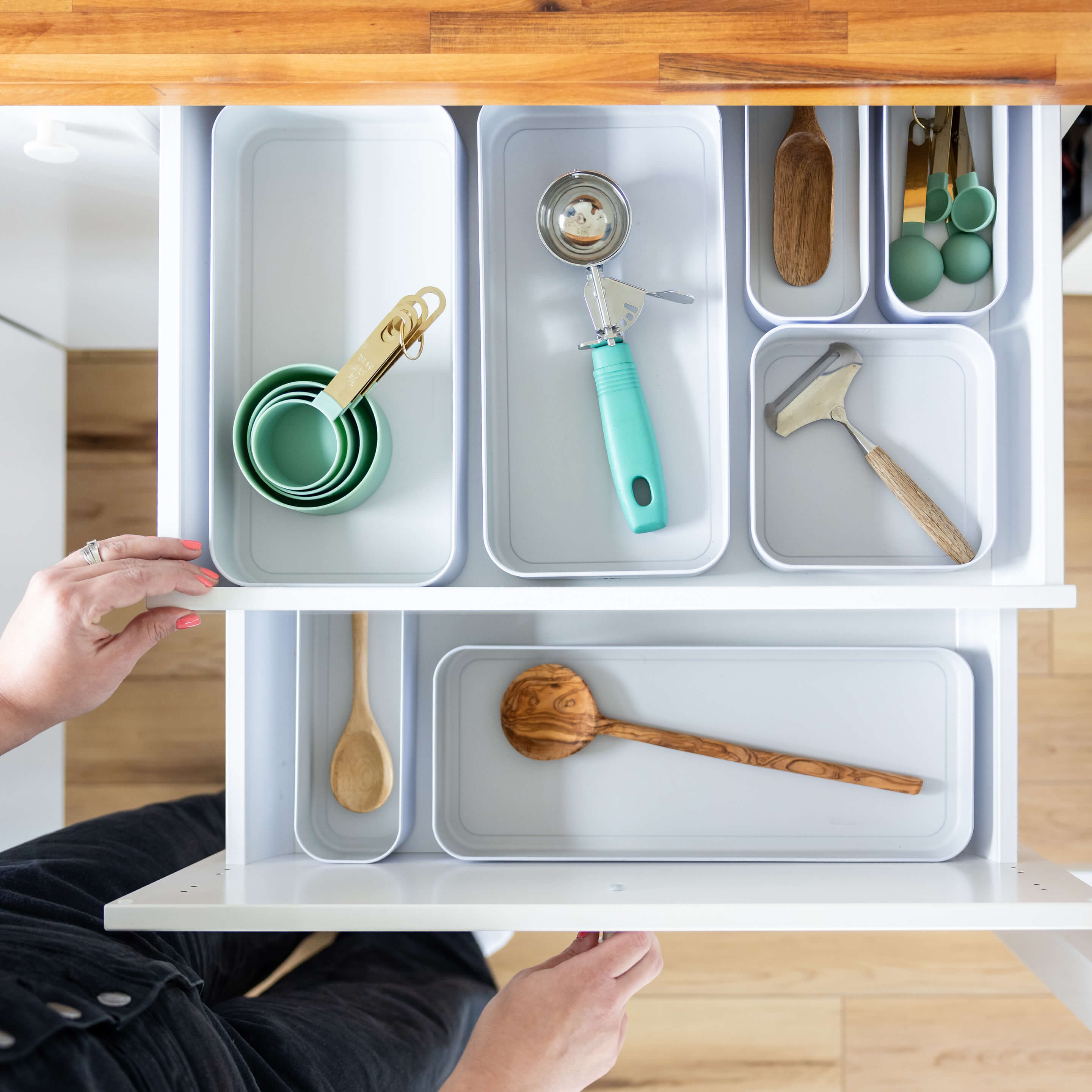
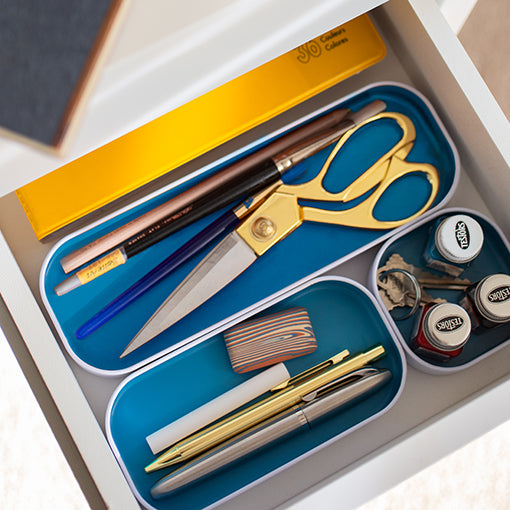
Minutes 9–13: rebuild with structure. Stackable metal drawer organizers give each category its own territory; felt bins handle the softer, odder-shaped stuff that doesn't sit neatly in a metal grid. Structure is what makes the reset permanent instead of cosmetic — without it, you're just repacking the same pile more neatly for a week.
Minutes 14–15: deliver the belongs-elsewhere pile to its actual destination immediately. Skipping this step is how "organized" becomes "relocated to the counter," which is arguably a worse problem than the one you started with.
Sequence for momentum
Start with the drawer that annoys you daily — usually the kitchen junk drawer — because the payoff is immediate and you'll feel it every single time you open it for the next month. Then bathroom, entryway, desk, nightstand, working roughly from most-used to least. Save the sentimental drawers for last; they run on different fuel, involve decisions about photos and keepsakes instead of dead batteries, and shouldn't be attempted at week one when you're still building the habit.
Track it without turning it into a chore
You don't need a spreadsheet, but a simple running list — even scribbled on the inside of a cabinet door — keeps you from accidentally skipping a drawer or redoing one you already finished. Checking a box is a small, disproportionately satisfying reward, and it turns an invisible habit into something you can actually see progress on. By week six or seven, that list becomes proof that fifteen minutes a week adds up to a genuinely different house.
The maintenance secret: there isn't one
Drawers with real interior structure mostly maintain themselves — the bins do the enforcement, because there's nowhere for clutter to spread once every item has its own small territory. When one drifts, it gets a spot back in the weekly rotation instead of triggering a full re-do. That's the entire system: fifteen minutes, one drawer, forever. Your house doesn't need a makeover. It needs a rhythm, and a rhythm is a much easier thing to sustain than a burst of motivation.
Frequently asked questions
Why does a 15-minute reset work better than a full weekend?
Because a single drawer is finishable — you can empty, sort, and rebuild it in one sitting, and finishing is what fuels momentum toward the next one.
Which drawer should I start with?
The one that annoys you daily, usually the kitchen junk drawer, so the payoff is immediate and felt every day.
What if a drawer stays messy after I reset it?
Just add it back into the weekly rotation. Drawers with real interior structure mostly maintain themselves — the bins do the enforcement.
What organizers should I use to rebuild a drawer?
Stackable metal drawer organizers for anything with hard edges, and felt bins for the softer or odder-shaped items — the structure is what makes the reset permanent.
Should I save sentimental drawers for later?
Yes — sentimental drawers run on different emotional fuel than a junk drawer, so save them for after you've built momentum with a few easy wins.