















Drawer Dividers Changed My Mornings: The Case for Structured Clothing Drawers
The difference between a drawer you dig through and a drawer you glance into is about ninety seconds every morning — which adds up to something like seven hours a year spent excavating for the other sock. Structure pays fast, and it pays in the currency that actually matters before 8 a.m.: time, patience, and not being late. Most people blame their drawers for being too small or their wardrobe for being too big. Almost always, the real issue is that nothing inside the drawer has walls. Add walls, and drawer organization stops being a daily negotiation and starts being a glance.
File, don't stack
Stacked clothes hide everything below the top item, which means you're only ever choosing from whatever landed on top last laundry day. Pulling from the middle of a stack wrecks the pile above it, so the shirt you actually wanted comes out along with three others that now need refolding. Filing — folding items to stand on edge, spine up, like books on a shelf — shows you every shirt at once, no digging required. But filing only survives inside walls, which is where dividers come in: without them, the files fall like dominoes by Wednesday, and you're back to a stack by Friday whether you meant to restack it or not.
Small territories for small things
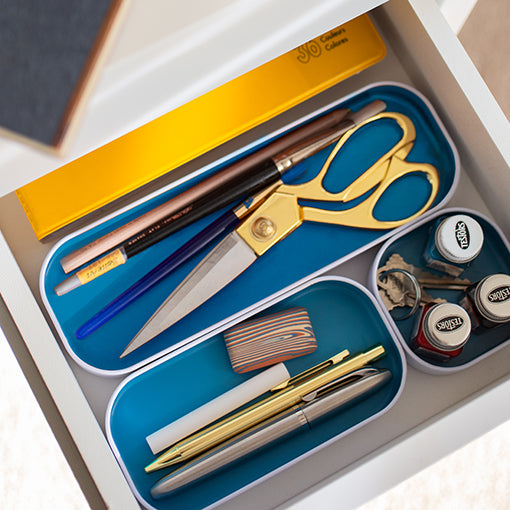
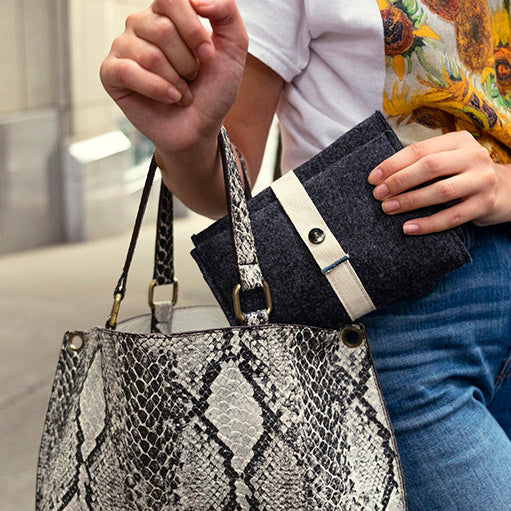
Socks, underwear, belts, and tights don't need folding — they need corralling. Left loose in a drawer, they migrate, tangle, and pool into a single sock-and-underwear soup that takes longer to search than a stack of shirts would. Smaller nesting felt bins dropped into a drawer create instant districts: one for socks, one for underthings, one for the miscellany that doesn't have anywhere else to live — hair ties, spare buttons, the tag you keep meaning to read. A drawer organizer insert works the same way for anything with harder edges, like jewelry or belts with buckles. Everything stays visible, nothing migrates, no morning archaeology required to find a matching pair.
Choose structure based on what the drawer holds
Not every drawer needs the same fix, and buying one type of organizer for the whole dresser usually means half the drawers are over-equipped and the rest are still a mess. Soft, foldable items — shirts, filed and standing on edge — mostly need dividers to keep the files from toppling. Loose, small items need felt bins or a drawer organizer with individual compartments so nothing rolls to the back corner and disappears. Deep drawers benefit from stacking bins that use the vertical space instead of leaving dead air above one layer of folded clothes. Matching the tool to the contents is what makes clothing drawer organization actually stick.
The one-drawer-per-category rule
When a category outgrows its drawer, the instinct is to annex the next drawer over — just a few t-shirts spilling into the sock drawer, just this once. Resist it. The drawer is the budget: too many t-shirts for the t-shirt drawer means it's donation time, not expansion time, and letting one category creep into another is how an entire dresser slowly loses its structure, drawer by drawer, until nothing has a fixed home anymore. Fixed containers are honest friends — they tell you the truth about how much you actually own, and they don't let you quietly ignore it the way an infinitely expandable pile would.
Ten minutes per drawer, once
This isn't a weekend project, and treating it like one is why so many closet organization plans stall before they start. One drawer takes about ten minutes: empty it completely, cull the never-worn layer that always seems to settle at the bottom, add structure with small felt bins or dividers, and file everything back in standing up. Do one drawer a day for a week and the whole dresser is done before Saturday, with no single day feeling like a project. Small, contained tasks are just easier to actually finish than one big overwhelming reorganization that keeps getting pushed to next weekend.
Maintenance is a five-second habit, not a redo
Once the drawer has real structure, keeping it that way stops being a chore — putting laundry away becomes filing one shirt into its existing slot, not deciding where anything goes from scratch. The felt bins and dividers do the remembering for you, so a five-second habit replaces what used to be a monthly reset. If a drawer starts sliding backward into a pile, that's a signal the category has outgrown its container, not a reason to abandon the system. A quick cull and refile — five minutes, not ten — puts it right back where it started.
Frequently asked questions
What does "filing" clothes mean?
Folding items to stand on edge instead of stacking them flat, so you can see every item at once instead of just the top layer.
Do I need dividers for filing to work?
Yes — without walls to hold them up, filed clothes fall over like dominoes within a few days.
How long does organizing one drawer take?
About ten minutes: empty it, cull anything never worn, add structure with small felt bins, and file everything back in.
What should go in the small felt bins inside a drawer?
Anything that doesn't need folding — socks, underwear, belts, and tights work best, each getting its own small territory.
What if a category won't fit in its assigned drawer?
Treat the drawer as the budget, not the closet. Too many items for the space means it's time to donate, not to annex another drawer.