




















Cord Chaos: A Sane System for Chargers, Cables, and the Drawer of Tangled Regret
Somewhere in your home is a drawer, basket, or bag containing every cable you've ever owned, braided together into a single organism with no discernible beginning or end. You keep them because "we might need it," and you can't find the one you actually need because it's fused to nine you don't. Cord chaos is universal — practically every household has a version of this drawer — and it's one of the fastest organizing wins in the house, because unlike sentimental clutter, almost nothing in it actually matters to you.
The great cable amnesty
Pull every cable you own into one pile, no exceptions, including the ones tangled behind the TV and the ones living in a kitchen drawer for no particular reason. Now the only sorting question that matters: do you own a device this connects to? Orphaned chargers for phones you recycled in 2019 don't become useful through loyalty, and "it might fit something someday" has never once come true in the history of cable drawers. Match cables to living devices; everything unmatched goes to electronics recycling, not the trash, since most municipalities have a drop-off specifically for this. Most households cut their cable population in half in ten minutes flat.
Sort by where, not what
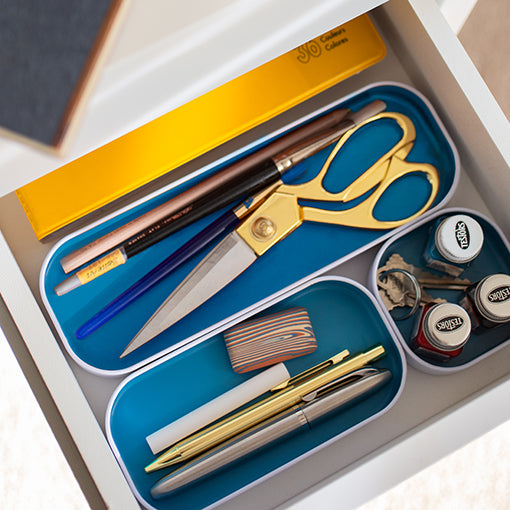
Don't organize cables by type — organize them by where they're used. A travel set, a desk set, a living room set, each built around what you actually do in that spot rather than what kind of cable it technically is. Each set gets its own small container: felt bins work beautifully here because the soft sides protect connectors from getting bent or scratched, and the sizes nest to fit whatever drawer or shelf you're using, from a nightstand cubby to a full closet shelf. Label by location, and lending a charger stops meaning dismantling the system — you just grab from the travel bin and put it back when you're home.
Wrangle the daily chargers
The cables you use every day shouldn't live in a drawer at all — they should live where they're used, contained but accessible. A small bin by the nightstand or on the entry shelf keeps the daily chargers coiled and grabbable instead of dangling behind furniture or snaking across the floor where someone trips on them. The distinction matters: storage is for sometimes, stations are for every day, and mixing the two is how a drawer that should hold three things ends up holding thirty.
Tame the tangle at the source
Even sorted cables tangle if they're just coiled loose in a bin, so take the extra ten seconds to loop each cable and secure it with a twist tie or a cable clip before it goes in. It feels like a small, fussy step, but it's the difference between reaching into a bin and pulling out exactly what you need versus reaching in and pulling out a fistful of everything. A little structure at the cable level means the bin-level system actually holds up over months, not just on the day you organized it.
Keep the mystery cable quarantine
There will always be two or three cables you can't identify but can't quite discard, the ones that might be for a router, or a game console, or something you genuinely can't picture. Fine — give them one small designated bin, and here's the rule: if a cable sits in quarantine through two audits without being claimed, it graduates to recycling. Doubt gets a home; doubt doesn't get the whole drawer, and a hard rule like this is what keeps the quarantine bin from quietly becoming the new junk drawer under a different name.
Frequently asked questions
How do I know which cables to keep?
Ask one question: do you still own a device it connects to? If not, it goes to electronics recycling — loyalty isn't a reason to keep an orphaned charger.
Should I organize cables by type or by where I use them?
By location. A travel set, a desk set, and a living room set each in their own felt bin is far easier to maintain than sorting by cable type.
What do I do with cables I can't identify?
Give them one small quarantine bin. If a cable sits there unclaimed through two audits, it graduates to recycling.
Where should everyday chargers live?
Not in a drawer — keep them where they're used, in a small bin by the nightstand or entry shelf, coiled and grabbable instead of dangling behind furniture.
How much can decluttering cables actually reduce clutter?
A lot — most households cut their cable population roughly in half in about ten minutes once orphaned chargers for devices they no longer own are removed.